


March 24, 2026
The Future of Resilience: Three Lessons from Insurtech Insights London 2026
By Laurent Peguret, Chairman, Dirox
London, earlier this week. Six thousand of the insurance industry's most forward-thinking leaders gathered at the InterContinental London – The O2 for Insurtech Insights Europe 2026. The conversations were sharp, the stakes were clear, and one conviction emerged stronger than any other: the experimental phase of AI is behind us. What lies ahead is an industrial-scale race, and the winners will not be those with the most data, but those with the most intelligent and resilient operations.
Three strategic themes stood out as defining the next chapter of our industry.
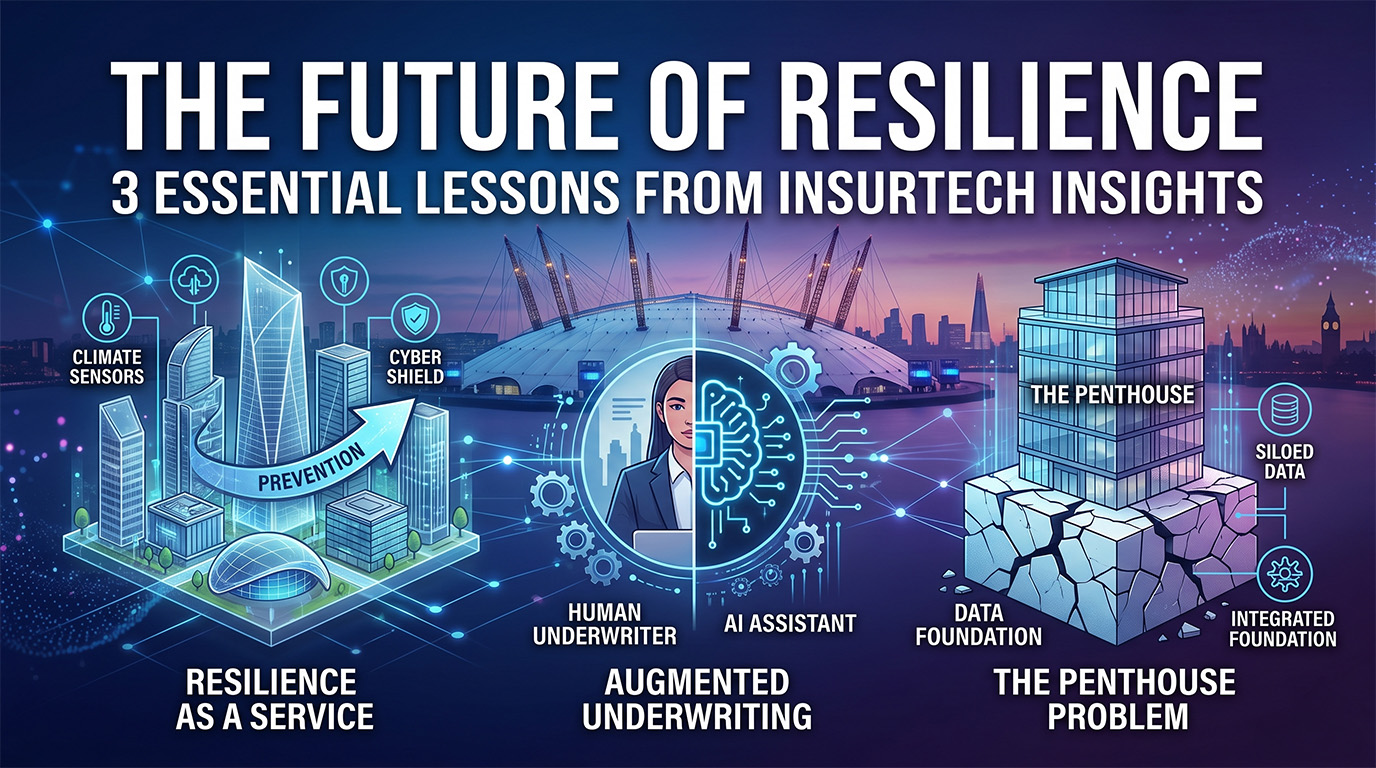
1. Beyond Payouts: The Rise of Resilience as a Service
The panel "Think the Unthinkable" opened with a question that cut to the heart of the industry's identity: are we risk transfer players, or risk managers?
Dominique Roudaut and Florian Graillot made the case that as risks grow more volatile, from climate events to cyber warfare, simply carrying risk on a balance sheet is no longer a sustainable growth strategy. The winners will be those who shift from reimbursing losses after the fact to preventing them before they occur. Call it Resilience as a Service.
The adversarial dimension of this shift was equally striking. Jan Syrinek of Resistant AI introduced the concept of "Zero-Day Fraud", generative tools now allow fraudsters to architect authentic-looking claims at scale. The move from independent to adversarial risk means our systems must evolve from simple prediction toward deep verification and behavioral intelligence.
2. Augmented Underwriting: When Efficiency Unlocks Judgment
The results presented by Sofia Kyriakopoulou of SCOR offered one of the most compelling blueprints of the conference for human-AI collaboration.
By automating the mechanical extraction of medical and vital data, SCOR has achieved time savings of 30 to 40 percent. But the real strategic unlock is not speed, it is focus. Standardizing the thinking process frees underwriters to concentrate their expertise on the complex cases that genuinely require human empathy and nuanced judgment. And by grounding AI in actual underwriting guidelines rather than pattern matching alone, SCOR has reached 90 percent accuracy while effectively eliminating the hallucination risks associated with standard large language models.
3. The Penthouse Problem
The session "Digging for Gold," featuring AXA and Schneider Electric, produced what may be the sharpest metaphor of the entire event. Henry Jenkins of Kensho called it the Penthouse Problem: AI creates a sleek, polished interface, the penthouse. But if that penthouse sits on a foundation of poor, unstructured, siloed data, the cracks will show the moment you move past the boardroom demo.
Una Shortt of Schneider Electric added a critical corollary: in a softening market, chasing every use case is a trap. The discipline lies in doing more with less, focusing on the data that truly moves the needle. And increasingly, data literacy cannot remain the sole domain of the CDO. From field agents to the C-suite, understanding the full lifecycle of data is the only way to ensure the penthouse remains standing.
A Final Word
The pace of change in this industry is at Formula One levels. The gap between organizations carrying legacy technical debt and those already operating in an agentic world is widening, fast.
At Dirox, our mission is to build the strong foundations that allow our partners to lead this transition. Not just software, but the resilience required for the next decade of insurance.
Other articles





.png)

.svg)

Ready to Launch Your Big Idea?
Get a free consultation with software experts to turn your tech vision into reality.


